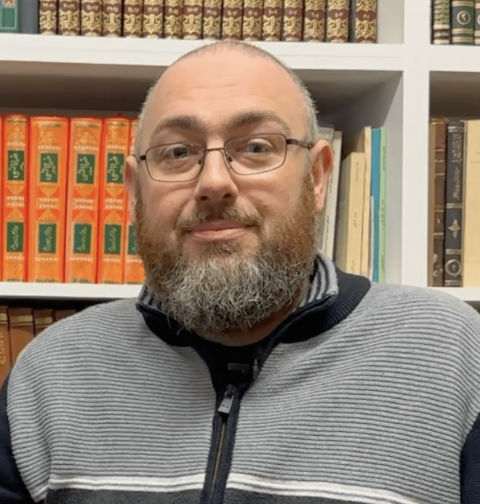
Dr Ramon Harvey
Lecturer of Islamic Studies, Ebrahim College- Muslim Seminary, London
Biography
Dr. Ramon Harvey is a distinguished scholar and lecturer in Islamic Studies with a particular focus on Islamic theology, Qur’anic studies, and Islamic philosophy. Currently a lecturer at Cambridge Muslim College, he has built a reputation as a leading voice in the study of Islamic theology, particularly within the Māturīdī school of thought. With an academic background that spans Islamic theology and modern Western philosophy, Dr. Harvey has made significant contributions to the academic study of Islam through both his teaching and his extensive publications.
01Academic Formation and Research
Dr. Ramon Harvey's journey into Islamic studies began at the renowned School of Oriental and African Studies (SOAS), University of London, where he pursued his doctoral studies. His PhD research focused on the development of early Islamic theology, particularly within the Māturīdī school, one of the major theological traditions within Sunni Islam. This rich academic grounding in Islamic thought has positioned Dr. Harvey as a key figure in modern discussions on kalām (Islamic theology).
His research interests are broad but focused around some key areas: early Māturīdī kalām, the philosophy of Islamic law, and constructive Islamic theology. Dr. Harvey is particularly interested in how traditional Islamic theology can be applied to contemporary issues and philosophical discussions. His work engages deeply with classical Islamic texts while also bringing them into dialogue with modern intellectual currents, including analytic philosophy, Christian theology, and phenomenology.
One of Dr. Harvey’s most notable academic achievements is his work on early Māturīdism, where he has contributed to the editing, translation, and analysis of foundational texts from the early periods of this theological tradition. This focus on textual scholarship is evident in both his publications and his teaching, where he emphasizes the importance of primary sources in understanding the development and nuances of Islamic theology.
02Publications and Contributions to Islamic Thought
Dr. Harvey is the author of several significant works that have garnered international attention in the fields of Islamic theology and Qur’anic studies. His first major book, The Qur’an and the Just Society (2018), published by Edinburgh University Press, explores how the Qur’an outlines the principles of justice and how these principles can be applied to the creation of a just society. The book is a deep investigation into the ethical and legal dimensions of the Qur’an, positioning it as a central text in the Islamic intellectual tradition and contemporary Muslim thought.
His second major publication, Transcendent God, Rational World: A Māturīdī Theology (2021), is a landmark study that delves into the theological and philosophical aspects of the Māturīdī school of kalām. This book examines the ways in which early Māturīdī scholars reconciled the transcendence of God with rational investigation of the world, contributing to a deeper understanding of Islamic theology’s engagement with reason. The book not only highlights the historical development of the Māturīdī school but also presents its relevance in modern theological discussions.
Dr. Harvey’s ongoing research continues to push the boundaries of Islamic theology by engaging it with contemporary philosophical and theological discourses. His focus on constructive Islamic theology seeks to develop a meaningful Islamic intellectual framework that resonates with modern contexts, especially in conversation with Christian theology and modern Western philosophy.
03Teaching and Academic Leadership
As a lecturer at Cambridge Muslim College, Dr. Ramon Harvey is deeply involved in teaching and mentoring the next generation of Islamic scholars. His courses cover a wide range of topics, including Qur’anic studies, Islamic law, and classical Islamic theology, with a particular emphasis on the Māturīdī tradition. His students appreciate his ability to bridge the gap between traditional Islamic thought and contemporary intellectual challenges, making his classes not only academically rigorous but also highly relevant for modern scholars and students alike.
Beyond his role as a lecturer, Dr. Harvey is also the Series Editor for the Edinburgh Studies in Islamic Scripture and Theology, a prestigious academic series that focuses on publishing high-quality research on Islamic thought. In this capacity, he helps to shape the direction of future scholarship in the fields of Islamic scripture and theology, ensuring that rigorous and innovative work continues to be produced in these critical areas.
Dr. Harvey's leadership within the academic community is not limited to his teaching and editorial roles. He regularly presents at international conferences, contributes to academic journals, and participates in interfaith dialogues, where his expertise in both Islamic and Christian theology offers valuable insights. His work in this area reflects his commitment to building bridges between different religious and intellectual traditions, fostering mutual understanding and respect.
04Engagement with Broader Intellectual Discourses
In addition to his work in Islamic theology, Dr. Ramon Harvey is deeply engaged with broader philosophical and theological discussions. His expertise in analytic philosophy and phenomenology enables him to bring fresh perspectives to classical Islamic texts, while his knowledge of Christian theology allows for meaningful interfaith dialogue and comparative theological studies.
This interdisciplinary approach is one of Dr. Harvey's most significant strengths. He believes that Islamic theology must engage with contemporary intellectual trends in order to remain vibrant and relevant. His work seeks to demonstrate that Islamic thought, with its rich history of rational inquiry and theological reflection, has much to contribute to the ongoing discussions within the fields of philosophy and theology today.
05Conclusion
Dr. Harvey is a leading scholar of Islamic theology, with a special focus on the Māturīdī school and constructive Islamic theology. His work not only preserves the rich heritage of Islamic thought but also pushes it into new and exciting intellectual directions. Through his teaching, research, and publications, he continues to inspire both his students and his colleagues, contributing to the development of a robust and meaningful Islamic intellectual tradition that speaks to the challenges and opportunities of the modern world.